
WELCOME BONUS 300%
UP TO €2000 + 100
FREE SPINS
UP TO €2000 + 100
FREE SPINS
Home → Blackjack
Blackjack at Fast Payout Casino: Variants, Rules and Payouts
Perfect Pairs vs 21+3 in House Edge
The Infinite Blackjack table by Evolution offers four side bets including the 21+3 variant, which carries a house edge of 7.47% when playing with six to eight decks. This specific edge is significantly higher than the base game RTP of 99.47%, making it a costly addition for players who do not count cards. The payout structure rewards specific hand combinations but statistically drains the bankroll faster than standard play over time.
Quantum Blackjack Plus by Playtech features multipliers up to 1,000x on three-card combinations totaling 21 points, operating with an RTP of 99.57%. While the potential for high multipliers attracts attention, the underlying house edge remains tied to optimal strategy execution rather than pure luck. Players must compare this against the 6:5 payout rule found in some variants, which adds 1.39 percentage points to the house advantage.
Comparing the two providers reveals that Evolution's standard side bets generally align with typical casino expectations, whereas Playtech introduces volatility through its quantum mechanics. A player betting 10 EUR on a side bet might lose the entire stake due to the high house edge, unlike the main game where basic strategy reduces risk. This distinction dictates that side bets should be viewed as entertainment expenses rather than viable winning strategies.
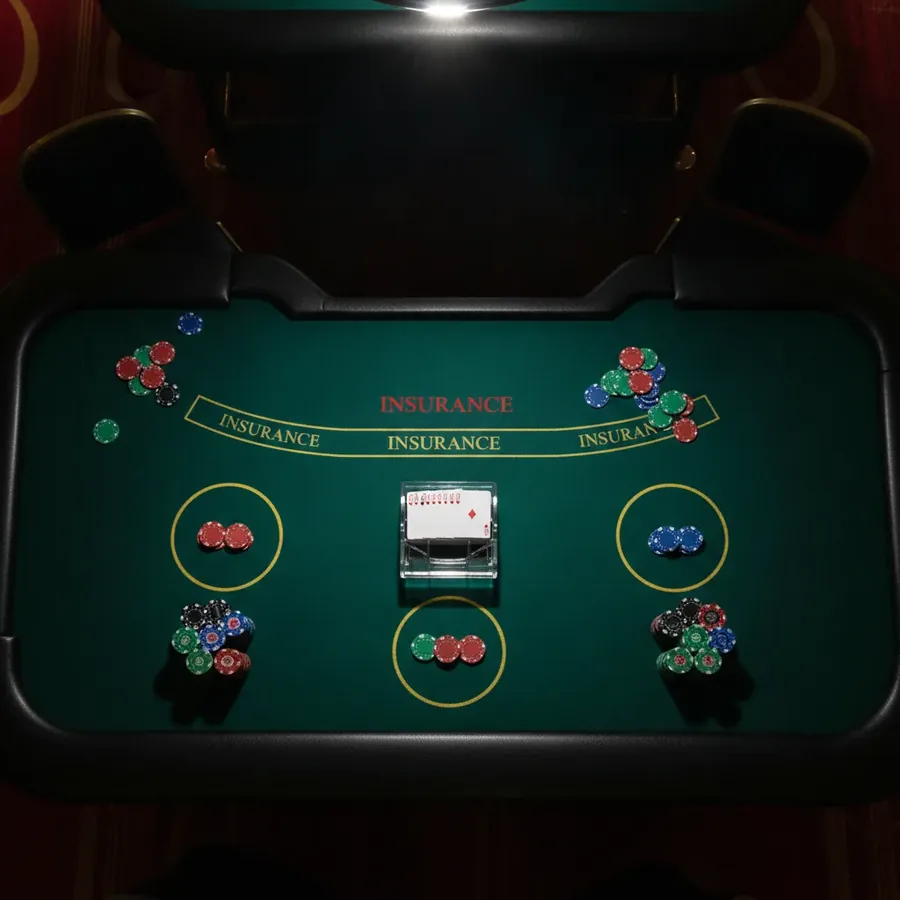
Error insurance: 7 percent additional house edge
Blackjack Insurance is a separate side bet available when the dealer shows an Ace, paying out at 2:1 if the dealer has a ten-value card underneath. The house edge for this bet sits at 7.47% for games using six to eight decks, which drastically reduces the overall return compared to the main game. Mathematical analysis confirms that basic strategy always advises rejecting this bet unless the player is counting cards with a true count of +3 or higher.
In a single-deck game, the insurance house edge drops slightly to approximately 5.88%, yet it remains prohibitively expensive for the average player. Accepting insurance effectively halves the potential win from a natural blackjack while increasing the long-term cost of play by nearly eight percent. This mathematical reality makes insurance a poor choice for anyone adhering to strict bankroll management principles.
The term 'error insurance' refers to the common misconception that buying protection mitigates risk, when it actually guarantees a negative expected value. For every 100 EUR wagered on insurance, the player can expect to lose roughly 7.47 EUR over the long run. This loss rate is nearly ten times higher than the 0.46% house edge found in the base 6-deck game without insurance options.
Chose Wrong Table for 5 EUR Bankroll
A 5 EUR bankroll is insufficient for playing Quantum Blackjack Plus, which requires minimum bets starting at 1 EUR and allows wagers up to 5,000 EUR. With such a low capital base, a single losing streak can deplete funds before the theoretical RTP of 99.57% has any chance to manifest. The variance associated with high-multiplier side bets further accelerates the depletion of small accounts, leading to rapid bankruptcy.
Infinite Blackjack by Evolution also sets a minimum stake of 1 EUR, accommodating small players better than high-limit tables, but the side bets remain dangerous. Betting 1 EUR per hand on the main game preserves the bankroll longer, yet adding side bets like Any Pair or Bust It increases the effective house edge. Players with limited funds should strictly avoid these modifiers to extend their session time and minimize losses.
Blackjack Party by Evolution presents a different constraint, with minimum bets set at 1.00 EUR and maximums capped at 1,000 EUR. While the limits are accessible, the festive atmosphere with two moderators does not alter the underlying mathematics of the game. A 5 EUR stack allows only five hands at the minimum, providing negligible entertainment value and zero margin for error against the house edge.
Infinite Blackjack uses the Six Card Charlie
The Infinite Blackjack table by Evolution includes four side bets: Any Pair, 21+3, Hot 3, and Bust It, none of which constitute a Six Card Charlie rule. The main game follows standard blackjack rules where reaching 21 with six cards typically results in a push or loss depending on the specific variant's house rules.
Standard rules for Blackjack 6 Decks allow doubling on any two cards and after splits, but do not mention automatic wins for six-card totals. Without a Six Card Charlie rule, players must rely on hitting until they reach 17 or higher, increasing the risk of busting with a weak hand. This limitation contrasts with more liberal variants that might reward extended drawing sequences, thereby affecting the overall player advantage.
Players seeking a Six Card Charlie benefit should look for specific niche variants rather than relying on major providers like Evolution or Playtech. The absence of this rule in the Infinite Blackjack specifications means the house edge remains fixed at 0.53% (derived from 99.47% RTP) under optimal conditions. Deviating from basic strategy to chase rare six-card wins will inevitably increase the house advantage beyond acceptable levels.
What doesn't count as Blackjack after Split?
When splitting Aces in Blackjack, most rules restrict the player to receiving only one additional card per split Ace, preventing the formation of a natural blackjack. If a player receives a ten-value card on a split Ace, it counts as 21 points but not as a 'blackjack' for payout purposes, usually resulting in a standard 1:1 win instead of 3:2. This rule applies to the Liberal Vegas Strip variant which allows resplitting but maintains strict card limitations on aces.
The payout structure for a standard blackjack is 3:2, meaning a 10 EUR bet yields 15 EUR, whereas a regular 21 pays only 1:1, yielding 10 EUR. After splitting, even if the total reaches 21, the hand is treated as a regular win, significantly reducing the expected return on investment. This distinction is crucial for players calculating their actual returns versus the advertised RTP of 99.72%.
Insurance bets are also restricted after splitting, particularly when the dealer shows an Ace, as the insurance wager is typically only allowed on the initial two cards. Attempting to insure a split hand is generally prohibited by casino rules, leaving the player exposed to the risk of dealer blackjack without compensation. Understanding these exclusions helps players manage their bankroll more effectively during complex split scenarios.
Blackjack variants at a glance
| Variant | Payout | House edge | Rule | Bet range |
|---|---|---|---|---|
| Blackjack Liberal Vegas Strip (liberale Regeln, 3:2) | 99.72% | 0.28% | Günstigste Regelkombination: S17 + DAS + Resplit + Late Surrender. Standardabweichung 1,15 | Blackjack 3:2, Gewinn 1:1 |
| Blackjack Surrender (Late Surrender) – Regel-Effekt | n.a. (Regel-Modifikator) | −0.08 Prozentpunkte | Spieler gibt Hand nach Dealer-Blackjack-Prüfung auf, verliert die Hälfte des Einsatzes. Verbessert RTP um ca. 0.08 Prozentpunkte. Early Surrender ist wesentlich wertvoller (bis −0.6 Prozentpunkte), aber extrem selten. | Rückzahlung 50% des Einsatzes |
| Blackjack Ein Deck, klassische Regeln, 3:2 | 99.85% | 0.15% | Weniger Decks = niedrigerer Vorteil; ein Deck gibt ca. −0.48 Prozentpunkte gegenüber 8 Decks. Oft durch 6:5 Auszahlung kompensiert. | Blackjack 3:2, Gewinn 1:1 |
| Blackjack 6 Decks, S17, DAS, DOA, Auszahlung 3:2, Basisstrategie | 99.54% | 0.46% | Dealer steht auf Soft 17; Verdopplung auf jeder Zweierkarte; Verdopplung nach Split erlaubt; keine Aufgabe. Basisstrategie ist für diesen Wert zwingend | Blackjack 3:2, normaler Gewinn 1:1, Insurance 2:1 |
| Blackjack Insurance / Versicherung (6–8 Decks) | 92.53% | 7.47% | Separate Nebenwette bis 50% der Hauptwette, wenn der Dealer ein Ass hat. Basisstrategie schreibt IMMER Ablehnung vor (außer Karten zählen bei True Count ≥ +3). Bei einem Deck Vorteil ≈ 5.88% | Insurance 2:1 |
| Blackjack Split / Double / H17 – Regel-Effekte | n.a. (Regel-Modifikatoren) | H17 +0.22 Prozentpunkte; RSA −0.08 Prozentpunkte; DAS −0.14 Prozentpunkte | Dealer Hits Soft 17 verschlechtert RTP um 0.22 Prozentpunkte; Resplit Aces verbessert um 0.08 Prozentpunkte; Double After Split verbessert um ca. 0.14 Prozentpunkte; 6 Decks statt 8 – ca. 0.02 Prozentpunkte. | Double – Einsatz ×2 mit einer Karte; Split – bis 4 Hände; Ass-Split meist mit einer Karte. |
When does the table max bet apply?
The Quantum Blackjack Plus Live variant from Playtech allows wagers ranging from 1 EUR up to a maximum of 5,000 EUR per hand. This upper limit ensures that high rollers can utilize the full potential of the game without hitting artificial caps during standard play sessions. Players must verify their current balance against this 5,000 EUR threshold before initiating any bets at this specific table. Exceeding this amount is technically impossible within the software interface.
Infinite Blackjack by Evolution also supports a maximum stake of 5,000 EUR, matching the highest limits found in other premium live dealer offerings. The unlimited seating feature means many players share this single table limit, requiring careful coordination when placing large wagers simultaneously. Each participant operates independently within this 5,000 EUR boundary, ensuring fair exposure for all seats available at the virtual table. The host manages the flow while respecting these strict financial boundaries.
Continuous Shuffling Machine shuffles after each round
Quantum Blackjack Plus Live utilizes a continuous shuffling mechanism that resets the deck composition immediately following every completed hand. This process eliminates card counting strategies by preventing players from tracking the remaining distribution of high or low value cards. The rapid cycle ensures consistent randomness across thousands of hands played during a single session without interruption. Players cannot exploit predictable patterns due to this immediate reshuffling protocol.
Bonus 100 EUR with 10 percent credit
Tischspiele contribute exactly 10 percent toward the wagering requirements of the 300% welcome bonus up to €2,000 plus 100 free spins. A deposit generating a 100 EUR bonus requires 4,000 EUR in total turnover because only one-tenth of blackjack stakes count toward this target. This slow accumulation rate contrasts sharply with slots, which contribute 100 percent and clear requirements four times faster. Players should calculate their expected turnover carefully before attempting to withdraw funds.
Statistics display saves the last 100 rounds
The statistics panel retains data from the most recent 100 rounds, providing a finite window into historical performance metrics. This limited scope prevents long-term trend analysis but offers immediate feedback on short-term variance and streak occurrences. Players reviewing the last 100 rounds can identify specific outcomes like insurance hits or busts without navigating complex archives. The data refreshes automatically as new hands are dealt and settled.
Soft Hand and Hard Hand Practically Distinguished
Dealer Hits Soft 17 rules increase the house edge by 0.22 percentage points compared to standing on soft seventeen variations. This rule distinction affects strategy significantly, forcing players to adjust decisions when the dealer holds an ace combined with a six. The additional 0.22 percent disadvantage reduces overall return-to-player rates slightly over extended playing periods. Understanding this difference is crucial for minimizing losses in multi-deck games.
Splitting costs double bet: plan budget
The Split mechanic allows players to divide a pair into two separate hands, each requiring an initial stake equal to the original wager. This rule effectively doubles the immediate financial exposure for that specific round compared to playing a single hand. Consequently, a €10 starting bet becomes a €20 commitment when splitting occurs, which must be accounted for in the total session bankroll.
Resplitting Aces improves the Return to Player (RTP) by approximately 0.08 percentage points according to standard Blackjack rules. However, this benefit is often offset by the increased volatility and the higher total amount of money risked during the extended play sequence. Players should calculate their maximum acceptable loss per split scenario before engaging with tables offering this feature.
Double After Split (DAS) provides a further 0.14 percentage point improvement to the RTP, making it a valuable rule variation. The ability to double down on split cards adds strategic depth but also increases the frequency of larger bets within a single hand cycle. Managing the budget requires anticipating these potential escalations rather than assuming the initial stake remains constant throughout the deal.
What a Natural Blackjack Practically Pays Out
Fast Payout Casino utilizes a 6-deck shoe where Natural Blackjack pays out at 6:5 instead of the traditional 3:2 ratio. A standard winning hand pays 1:1, but the special 21 combination returns only $12 on a $10 wager rather than the expected $15. This structural difference reduces the player's return significantly compared to games adhering to the older payout standards.
The house edge stands at 1.85% for this variant, which is 1.39 percentage points higher than the 0.46% edge found in standard 3:2 games. This increase represents the strongest negative impact of any single rule change available in typical casino environments. The lower payout directly translates to a slower accumulation of winnings over hundreds of hands played.
Optimal strategy is mandatory to minimize losses in this high-edge environment, as deviations will accelerate bankroll depletion. The game lacks late surrender options, forcing players to accept full losses on weak hands against strong dealer upcards. Understanding this mathematical disadvantage is crucial for setting realistic expectations regarding long-term profitability.
How long does a Live Blackjack round take?
Infinite Blackjack by Evolution accommodates unlimited seats at the table, allowing multiple players to act simultaneously without delay. The Quantum Blackjack Plus variant by Playtech introduces multipliers up to 1,000x on three-card combinations, adding complexity to the decision phase. These features extend the average duration of a single round beyond standard fixed-limit tables.
Quantum Blackjack Plus operates with a betting range from €1 to €5,000 and offers an RTP of 99.57% under optimal strategy. The presence of side bets like Any Pair or Hot 3 in Infinite Blackjack adds additional decision points for interested players. Each additional interaction increases the total time required to complete one full cycle of play.
Blackjack Party by Evolution includes two moderators to create a lively atmosphere, potentially influencing the pace of conversation and decisions. While the core card dealing mechanics remain consistent, the social elements can slightly prolong the time between bets. Players seeking rapid gameplay should avoid these themed tables in favor of more streamlined options.
Insurance Pays 2:1 Yet Still Costs Money
The Insurance side bet pays 2:1 if the dealer reveals a Natural Blackjack after checking their hole card. This wager is limited to 50% of the main stake and activates only when the dealer shows an Ace. Although the payout appears attractive, the underlying probability makes it a losing proposition for most players.
The house edge for Insurance stands at 7.47%, drastically reducing the overall Return to Player (RTP) to 92.53%. Base strategy dictates always declining this bet unless the player is counting cards with a true count of +3 or higher. Accepting insurance erodes the bankroll much faster than playing the main hand alone.
A single-deck game reduces the insurance house edge to approximately 5.88%, yet it remains inferior to the main game's performance. Multi-deck games further dilute the odds, making the 2:1 payout insufficient to compensate for the frequent losses. Avoiding this side bet preserves the integrity of the primary strategy's theoretical advantage.
When can you increase your bet?
Players may increase their wager through the Double Down option, which requires placing an additional bet equal to the original stake. This action is permitted only when holding exactly two cards and involves receiving precisely one more card from the dealer. It serves as a strategic tool to maximize profits on strong starting hands like 11 or 10.
Doubling After Split (DAS) extends this opportunity to cards received after a split, provided the specific table rules allow it. This rule improves the RTP by 0.14 percentage points, offering a slight mathematical advantage to the informed player. Access to this feature depends entirely on the specific configuration of the Blackjack variant being played.
Table games contribute only 10% toward bonus wagering requirements, while slots contribute 100%, affecting the efficiency of bonus usage. Increasing bets on Blackjack accelerates the clearance of these requirements due to the higher contribution rate relative to other table games. Players must weigh the speed of turnover against the inherent house edge of the chosen variant.
Contact
Live - online chat
Banking





Providers





Fast Payout Casinos 2026